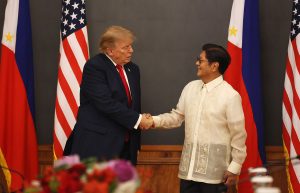
US PRESIDENT Donald J. Trump and his Philippine counterpart Ferdinand R. Marcos, Jr. hailed their countries’ alliance and pledged stronger ties in areas including trade and investment to help further strengthen relations.
Mr. Trump was in Manila before heading to Shenzhen to meet China’s Xi Jinping. He and Mr. Marcos held a bilateral meeting on Wednesday, reaffirming the importance of the two nations’ longstanding alliance and seeking new areas of cooperation, such as technology.
After the meeting, Mr. Trump said the two sides had “consummated a very big trade deal,” which hadn’t been on the agenda of the discussions.
While on the flight to China, Mr. Trump posted on social media that “we made a new and completely different Trade Deal with the Philippines, one that will be a true landmark and, in particular, a Deal that will be great for our Farmers and those in the business of ‘Energy.’”
Mr. Marcos didn’t mention an agreement on trade, and Philippine officials later said there was no deal on a tariff rate or specific commitments by either side.
“The US has offered to supply the Philippines with both energy resources and food products,” Finance Secretary Frederick D. Go said in a text message. “Our priority is to bring down the cost of these two essential commodities for every Filipino.”
Trade negotiators from the Philippines will now take forward their discussions with the US Trade Representative’s office, he said.
The White House didn’t immediately respond to a request for further information.
MILITARY TIES
Earlier, Mr. Trump pledged cooperation with the Philippines in energy projects, nuclear and defense. He highlighted the expansion of defense ties, including historic increases in foreign military financing and arms sales to the Philippines.
The military cooperation is key to their objective of building a stronger deterrence case against China in the disputed South China Sea. The US has secured expanded access to military sites in the Philippines, along with joint maritime patrols and pushed for collaboration on artificial intelligence (AI) and rare earths, including a proposed 4,000-acre industrial hub in Luzon.
Mr. Trump highlighted the Luzon Economic Corridor, an initiative of the two countries and Japan, in his comments on Wednesday, saying the goal was to draw $100 billion of investment into critical industries and bolster economic security in the Philippines.
“America stands with the Filipino people, as we have in generations,” Mr. Trump said at the start of his meeting with Mr. Marcos. “We’ve been your ally, but not as close as it is now.”
Earlier in the day, he wrote in the guestbook at the presidential palace: “The USA loves you!”
Mr. Marcos said there’s potential for new areas of cooperation with the US, “particularly in technology, where American leadership and innovation continues to lead the way.” There’s also opportunity to work more closely with the US on AI, and “as we look to the future, I am confident that we will find new and important ways to deepen our partnership,” he said.
Although brief, Mr. Trump’s visit is seen as an opportunity for the US to reassure Manila that the momentum in their relationship will continue.
The meeting comes at a time “when we are not confident of US commitment in Asia,” Rommel Ong, a retired rear admiral in the Philippine Navy, said before Mr. Trump’s arrival. “While we value the alliance with the US, we expect President Marcos to uphold Philippine interest first.”
Mr. Trump’s brief stop in Manila included meetings on Tuesday with leaders from India, Japan and Australia as part of the Quad group, and Southeast Asian leaders. He separately signed a joint trade statement with Thailand’s Prime Minister Anutin Charnvirakul declaring that the two countries had substantially concluded negotiations on an agreement.
In July, the Trump administration imposed a 12.5% tariff rate on the Philippines, along with several other countries, following a US investigation into alleged forced labor used in supply chains.
Ralph G. Recto, executive secretary to Mr. Marcos, said on Wednesday that the tariff rate would still be negotiated.
Jose Manuel Romualdez, Philippine ambassador to Washington, separately said the US offered “to diversify our food supply and energy requirements.” — Bloomberg
previous post
