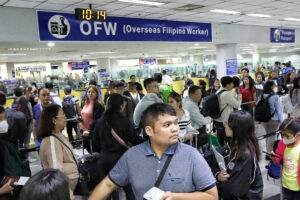
CASH REMITTANCES from overseas Filipino workers (OFWs) have so far proved resilient but ongoing global volatility affecting host countries could still drag its annual growth to a post-pandemic low, a foreign bank said.
In a report dated Nov. 16, Maybank Investment Bank economists said they see OFW remittances rising by 2.2% this year even as September inflows showed some recovery.
“(W)e maintain our projection for 2026 remittances at +2.2% year on year (YoY) or $36.4 billion, slightly below the BSP’s (Bangko Sentral ng Pilipinas’) latest +2.7% YoY growth target,” Maybank Chief Economist Suhaimi Ilias, Economist Azril Rosli, and Senior Economic Analyst Fatin Nabila Mohd Zaini said.
“Nevertheless, downside risks from heightened geopolitical tensions, particularly in the Middle East, remain elevated and could contribute to greater month-to-month volatility,” they added.
If the 2.2% remittance growth is realized, this would be the slowest full-year growth since the pandemic. Remittances fell by 0.8% to $29.903 billion in 2020.
Excluding the pandemic, 2026 would mark the weakest remittance growth in 25 years or since the 0.3% contraction in 2001.
Maybank’s forecast is also below the BSP’s 2.7% growth projection for cash remittances this year.
Latest central bank data showed cash remittances or funds coursed through banks by OFWs grew by 2.6% to $3.202 billion in September from $3.121 billion a year ago. This was the fastest uptick in eight months or since the 3.5% recorded in January.
Economists have said that the recovery was likely driven by OFWs sending more money home in preparation for the upcoming holiday season.
“The improvement suggests that underlying remittance momentum has strengthened, although cumulative growth remained moderate at +2.3% YoY in the nine-month period in 2026,” Mr. Ilias, Mr. Rosli, and Ms. Zaini said.
As of the end of the third quarter, cash remittances had risen by 2.3% year on year to $26.626 billion from $26.03 billion. This was slower than the 3.2% climb logged in the same period in 2025.
“Remittance flows continued to be supported by diversified source markets and broadly stable labor demand for OFWs, providing some buffer against external economic and geopolitical uncertainties,” Mr. Ilias, Mr. Rosli, and Ms. Zaini said.
As of September, the country had deployed a total of 1.449 million OFWs, 20.66% lower than the 1.827 million recorded in the same period in 2025, based on data from the Department of Migrant Workers.
Most OFWs were deployed to Saudi Arabia, the United Arab Emirates (UAE), Singapore, Hong Kong, Qatar, Taiwan, Japan, Kuwait, Australia, and South Korea.
Based on BSP data, the United States continued to be the top source of cash remittances as of September, accounting for 39.8% of total inflows. This was followed by remittances from Singapore (7.1%), Saudi Arabia (6.4%), Japan (5%), and the United Kingdom (4.7%).
Since the Middle East war broke out in late February, analysts have raised concerns over remittance flow disruption from the region after thousands of OFWs were repatriated.
However, the latest data showed that inflows from Middle Eastern countries picked up in September.
Citing BSP data, Maybank noted that remittances grew by 1.6% in September, faster than 1.1% in August, while those from Qatar rose by 3.6%, picking up from 2.4%.
“The improvement across several Gulf economies suggests that remittance flows from the region remained relatively resilient despite ongoing geopolitical uncertainties,” Mr. Ilias, Mr. Rosli, and Ms. Zaini said.
However, Maybank noted that inflow trends from Asia were mixed in September. Remittances from Japan eased to 3.3% from 3.9% in August, while inflows from Hong Kong picked up to 3.5% from 3.4%.
“Collectively, continued positive growth across major source markets points to the resilience of remittance dynamics,” the Maybank economists said.
“While performance remained uneven across individual markets, the diversification of remittance sources continues to provide an important buffer against external shocks, helping sustain overall OFWR (OFW remittance) inflows amid heightened global uncertainty,” they added.
The central bank has noted that OFW remittances remain a key driver of household spending and local economic activity even as inflows moderated in recent months.
The BSP expects cash remittances to climb by an annual 2.7% to $36.6 billion in 2026 from $35.6 billion in 2025. — Katherine K. Chan