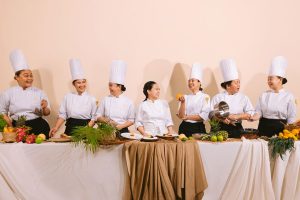
CONRAD MANILA is placing its female chefs front and center for a set menu called “Filipinas” at Brasserie on 3.
BusinessWorld attended a luncheon on Aug. 24 which served as the preview for the menu. The seven-course meal will be offered at a special dinner on Sept. 12 at 6 p.m., while a smaller menu with four courses will be offered starting Sept. 12, until further notice.
Guests were offered menus printed with a map of the Philippines, with a dot corresponding to the region from which the dish (or the corresponding chef who made it) came. Each dish has been ascribed a Filipino name. For example, Rachelyn Bautista, Chef de Partie of C Lounge, created the starter, Simula (beginning). It’s a tokwa’t baboy — a dish combining tofu and pork — but instead of the cubes we’ve come to know, she does this as a wrap with minced etag (a smoked, cured, and dried pork dish from the Cordilleras) and tofu skin. Monica Francesca Manaig, Junior Sous Chef of Brasserie on 3 made Pagbukas (opening), a tuna kilawin. Patricia Joson, Junior Sous Chef at the Banquets Kitchen made Paglago (growth), a mushroom and cheese ravioli. Via Dalida, Chef de Partie at the Pastry Kitchen made Sandali (pause), a calamansi sorbet serving as a palate cleanser. Kristine Davis, Executive Sous Chef, made Direksyon (direction), a maya-maya (red snapper) and alugbati (Malabar Spinach) dish. Jazzel Jane Borcellis, Sous Chef of Brasserie on 3 made Lakas, which is laing (a coconut and taro-leaf dish) and tenderloin on a plate. The meal ended with Doreene Ien Valencia’s (Chef de Partie at the Pastry Kitchen) Pamana, a dessert combining cacao cream and guyabano chiboust.
THE DISHES
The starter was really a great introduction and set expectations high: it still tasted quite the same, albeit smokier, than the tokwa’t baboy we’ve grown quite accustomed to, with refinement and novelty usually not found in the dish. The tuna kilawin course was wrapped in a corn husk. While there was an expectation met in how kilawin should taste like (it’s fish which is cured or cooked in citrus), extra ingredients like popped sorghum and corn add a little oomph in terms of texture and the dish comes out new.
The ravioli had an amazing pillowy texture, and the mushroom and cheese were accompanied by a salted egg creme that gives the mild dish a little jolt — we will say that despite its comforting taste, it fades into the background next to the other more flamboyant flavors of the menu. The fish and alugbati dish of Ms. Davis, meanwhile, expertly melded the flavors of each element, all standing on the solid ground of heirloom black rice. The laing and tenderloin dish, meanwhile, showed the level of refinement a humble dish could take on, provided it was made with care.
The dessert, which we would otherwise have avoided because of the fruit, ended up being quite delightful, and showed us a new way to enjoy chocolate.
INSPIRATION
Conrad Manila’s general manager Rupert Hallam told us about the inspiration for the menu. “I don’t think Filipino food is celebrated enough as it should be,” he said. “There’s a resurgence of Filipino food, and I think it’s something to be very proud of. We’re certainly proud of the ladies putting the food together, and the passion behind it.”
Ms. Davis, meanwhile, told BusinessWorld, “Each course is personal to the chef who made it.” She said that the ingredients that she used were always present at her home, while she said that Ms. Borcellis’ laing dish was inspired by a memory of her father making it for her.
Prior to her stint at the Conrad (she has been at the property for less than a year), Ms. Davis worked in the US for about 15 years in the same industry. “I’ve done other cuisines, but I always somehow come back to Filipino cuisine,” she said. “It’s the perfect time for me to highlight what we already have. It’s already a beautiful cuisine.”
She tried to define Filipino cuisine, through her own experiences: “The approach is always about the flavor,” she said. While one can apply different techniques to make a Filipino dish, as long as one pursues the original flavor, it’s still Filipino. “It’s all about showcasing the flavor itself, and not focusing on the technique,” she said. “It doesn’t always have to be served in a specific way,” she added. “It’s so versatile that you can always apply different techniques. As long as you have flavors in mind — and in your heart — you can showcase Filipino flavors wherever you are.”
TOUGH WORLD
Speaking as a woman working in big kitchens for quite some time, she admitted that “It’s a tough world to move in.”
“It’s very difficult for me, as a Filipina: not only as a woman, but as a Filipino woman,” she said. “There are a lot of people who are very good. (But) the approach is always very manly. To me, I’d like to approach things in a very motherly way. I’d like to approach things with care, and a lot of passion. Not necessarily yelling, and always angry,” she said, pointing at the stereotypes of male chefs always making a ruckus in the kitchen (not to mention the usual representation of chefs as male in the media). “It’s all about just making sure you are seen in a way that you put your heart in everything that you do.”
The dinner on Sept. 12 will be offered between P3,088 net to P4,088 net, depending on the selections. Kordero at Piyanggang (a lamb and blackened coconut stew) is also on the menu, driving up the price to P3,588 net. Choosing vegan and the Maya-maya at Alugbati selections set it at P3,088 net, while opting for Baka at Laing increases the price to P4,088 net.
For more information, call 8833-9999 or e-mail ConradManila@ConradHotels.com. — Joseph L. Garcia