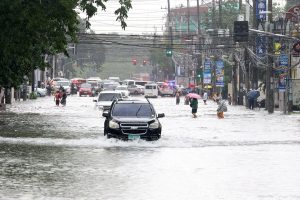
FLOODWATERS disrupted roads across Metro Manila on Monday as heavy rain brought by the southwest monsoon inundated several major thoroughfares, even as lawmakers questioned the proposed return of more than P100 billion in flood control spending under the 2027 national budget.
Several roads in Manila and Quezon City became impassable to light vehicles, with floodwaters reaching knee-deep or higher in some areas, according to the Metropolitan Manila Development Authority.
España Boulevard reached 24 inches of water near M. Dela Fuente Street, while portions of Rizal Avenue and Abad Santos Avenue were also knee-deep. In Quezon City, floodwaters reached 26 inches along A. Bonifacio Cloverleaf and parts of Araneta Avenue.
The flooding came as the government proposed P107.4 billion for flood control projects under the Department of Public Works and Highways (DPWH) for 2027, bringing renewed attention to whether the large allocation will translate into projects that can reduce flooding and whether the spending process can prevent the insertion of questionable projects.
At a House of Representatives Appropriations Committee hearing on Monday, Party-list Rep. Antonio L. Tinio questioned Budget Acting Secretary Kim Robert C. de Leon over the size and distribution of the proposed flood control allocation, as well as the possibility that project amounts could be altered during congressional deliberations.
Mr. Tinio said previous budgets showed a pattern in which some allocations were significantly reduced between the National Expenditure Program and the enacted General Appropriations Act, potentially creating room for congressional insertions.
“We noticed a pattern, I even called it a modus, of padding under the national expenditure program,” he said in Filipino. “This is what enables massive insertions.”
He cited foreign-assisted projects under the Department of Transportation and the Department of Public Works and Highways as examples of allocations proposed at higher levels in the National Expenditure Program but later reduced in the enacted budget.
“The pattern over the years is that what you submit under the national expenditure program is very large, but when it reaches the General Appropriations Act, it is significantly less,” Mr. Tinio said, asking whether the same pattern could recur in the 2027 budget.
Mr. de Leon said the Department of Budget and Management’s (DBM) proposed amounts for foreign-assisted projects were based on its assessment of actual project requirements. He said the figures in the National Expenditure Program were even lower than amounts initially requested by implementing agencies.
“The amounts we proposed in the national expenditure program align with our evaluated requirements for foreign-assisted projects,” Mr. de Leon said in Filipino.
Mr. Tinio then asked whether there would again be “massive insertions” in the 2027 budget.
Mr. de Leon said the proposed budget had been submitted and that the next stage of the process rests with Congress.
The lawmaker also questioned the distribution of proposed flood control projects. Of the 197 district engineering offices under the DPWH, only 113 have flood control projects in the proposed budget, he said.
Mr. Tinio cited the absence of proposed flood control projects across the Davao Region, despite the region also experiencing flooding.
Mr. de Leon said the DBM’s evaluation was based on project proposals submitted by the DPWH.
Mr. Tinio warned that the absence of projects in some areas could eventually lead to changes in the budget, potentially opening the door to insertions during congressional deliberations.
He also questioned whether some flood control spending should instead be directed toward other urgent needs, including classrooms.
Mr. Tinio noted that the government is targeting the construction of only about 700 classrooms in 2027 despite a reported nationwide shortage of roughly 160,000 classrooms.
Batangas Rep. Ryan Christian S. Recto, meanwhile, raised concerns over the government’s ability to implement the proposed increase in capital spending.
He asked whether the government had mechanisms to prevent underspending even as proposed 2027 capital outlays increase by 13.8%.
Mr. Recto also cited the economy’s 2.3% growth in the second quarter and the transfer of resources from government-owned and controlled corporations to the DPWH.
“What mechanisms do we have in place to prevent underspending because we’re increasing the budget but we haven’t seen to have solved the issue yet of underspending?” he asked.
Mr. de Leon said the DBM had subjected infrastructure projects in the 2027 budget to closer scrutiny, particularly on the completeness of documentary requirements.
This would allow implementing agencies to begin procurement earlier, he said.
“These projects that are in the 2027 National Expenditure Program already went through scrutiny in terms of completeness of documentary requirements,” he said. “The agencies responsible, not only DPWH but all the other agencies with infrastructure projects, can actually undertake early procurement.”
Mr. de Leon attributed part of the delayed implementation of infrastructure projects this year to late procurement.
‘LEADERSHIP FUND’
Meanwhile, Malacañang rejected claims that infrastructure funds were allocated to lawmakers, saying government resources are intended for specific projects rather than individual legislators.
Palace Press Officer Clarissa A. Castro said President Ferdinand R. Marcos, Jr. had neither discussed nor authorized a reported P24-billion “leadership fund” allegedly linked to the corruption scandal involving the DPWH.
“The funds are given to projects, not to individuals,” she told reporters in Filipino, adding that Mr. Marcos had instructed that infrastructure projects be distributed equitably across congressional districts.
Ms. Castro said the so-called leadership fund was never mentioned to Mr. Marcos and was also denied by the administration’s economic team.
She said the fund does not appear in the budget bill, adding that she had confirmed this with the DBM.
The Palace statement came after former Public Works Secretary Manuel M. Bonoan testified before the Sandiganbayan that incumbent senators in 2024 had accessed a multibillion-peso fund for priority infrastructure projects under the 2025 budget.
Mr. Bonoan, who is now in detention, made the disclosure during the graft and malversation trial of former Senator Ramon “Bong” B. Revilla, Jr. over a flood control project in Bulacan.
Ms. Castro said Mr. Marcos ordered an investigation after inconsistencies emerged in Mr. Bonoan’s reports.
The disclosures have drawn criticism in the Senate, with Senator Panfilo “Ping” M. Lacson earlier describing the reported arrangement as “a worse version of pork barrel,” referring to discretionary funds long associated with corruption allegations.
Former Senate President Juan Miguel F. Zubiri has denied directly managing project lists, saying legislative requests were coursed through the Senate Finance Committee.
The proposed 2027 budget will now undergo congressional deliberations, where lawmakers will determine whether the flood control allocation and other infrastructure funds remain at their proposed levels or are altered before the final spending measure is enacted. — Pexcel John Bacon, Erika Mae P. Sinaking and Norman P. Aquino