Filipinos are increasingly getting their news from social media, video platforms and algorithm-driven feeds instead of traditional news outlets, a shift that has contributed to declining trust in news, according to VERA Files co-founder and University of the Philippines professorial lecturer Yvonne T. Chua.
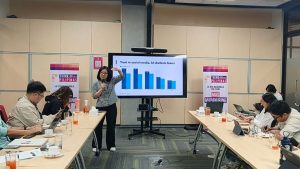
Speaking at the community discussion “Why Don’t Filipinos Trust the News Anymore?” in Mandaluyong City on Monday, Ms. Chua cited findings from the Reuters Institute Digital News Report 2026 showing that only 28% of Filipino respondents trust most news most of the time, down 10 percentage points from a year earlier. She is the author of the Philippine section in the report.
The decline mirrors a broader global trend. The Reuters Institute reported that trust in news across 48 markets fell to 37% this year, the lowest level since it began measuring trust in 2015. Trust declined in 29 of the 48 markets surveyed, with drops of at least five percentage points recorded in 19 countries.
“What we’re seeing now is what we call platform-led news consumption. Or, if you want, the technical term, the platformization of news,” Ms. Chua said.
For the first time since the Reuters Institute began tracking digital news habits, social media and video networks overtook both television and news websites as sources of news globally. The report found that 77% of respondents across 48 markets consume online news videos weekly, while 27% now watch on-demand news through applications such as YouTube on smart televisions.
Ms. Chua said Filipinos adopted these consumption patterns earlier than many countries, noting that audiences now primarily discover news through social media and video networks rather than through news websites, apps and other platforms controlled by news organizations.
“People are now looking for news outside of spaces that we control. They’re getting out of news websites and apps as well,” she said.
The Reuters Institute attributed part of the global decline in trust to changing consumption habits, noting that social media, video networks and artificial intelligence tools have historically been trusted less than traditional news outlets. As audiences spend more time on these platforms, overall trust in news tends to decline.
Ms. Chua echoed this finding, pointing to the Philippines’ growing reliance on platform-based news consumption and the decline of television news use. Citing a longitudinal study covering 46 markets, she said researchers found that “the sharp drop in trust in news was due to the reduction in the use of television.”
“TV is really important. It’s a very crucial one,” she added.
The shift has become more pronounced as Filipinos increasingly use smart televisions and streaming services. Ms. Chua said smart TV adoption has grown rapidly in recent years, creating new opportunities and challenges for news organizations seeking to reach audiences.
Globally, the Reuters Institute found that the growth in online news consumption is occurring almost entirely on third-party platforms. Video-led networks such as YouTube, Instagram and TikTok continue to expand their reach, while mainstream news organizations reported a five-percentage-point decline in video consumption on their own websites and apps.
Although respondents generally viewed established news organizations as more reliable than social media platforms and artificial intelligence chatbots, convenience continues to draw audiences toward alternative sources of information. Globally, trust in information from AI chatbots stood at 20%, while weekly use rose to 10% overall and 16% among people younger than 35.
“News is more reliable than AI chatbots. However, it is convenient. They don’t need to look for it,” Ms. Chua said.
The report also showed that concern over online misinformation remained high among Filipinos, with 66% of respondents expressing concern about false or misleading content online.
According to Ms. Chua, Filipinos now “navigate a very confused information environment where there’s lots of information circulating both vetted and unvetted,” contributing to growing skepticism toward information sources.
At the same time, interest in news continues to weaken. In the Philippines, interest in news dropped to 43% from 69%, while news avoidance increased. Globally, the Reuters Institute found that the proportion of people who are highly interested in news has fallen by an average of 13 percentage points since 2021, while the share of casual or passive news users rose to 25% from 16%.
Ms. Chua said the trend was particularly concerning among audiences who have become both less interested in and less trusting of the news.
“This is the largest, fastest-growing group,” she said. “Those who have lost trust and have lost interest in news.”
She also flagged the number of respondents who said news was difficult to follow or understand.
“When they tell us that news is very hard to follow or understand, that’s 13%, not 5% or 2%. It means, what are we doing wrong in terms of telling the story?” Ms. Chua said.
Despite the decline in overall trust, the Reuters Institute noted that trust in established news brands has remained more resilient than trust in news generally. Ms. Chua said this suggests that media organizations can still build on the credibility of their brands, provided they remain relevant and accessible to audiences.
“Trust building cannot be designed only for audiences who are already easy to reach,” she said. “A national trust strategy has to ask why poorer and less-educated audiences are less likely to trust them, and whether or not journalism is useful, accessible, and responsive.” — Kaizzer Angela Marie V. Manuba
previous post
