By Beatriz Marie D. Cruz, Senior Reporter
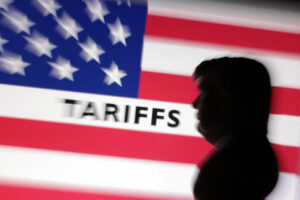
THE UNITED STATES’ 12.5% tariff on Philippine exports is expected to be a key agenda of President Ferdinand R. Marcos, Jr.’s bilateral meeting with US President Donald J. Trump in Manila this week.
Department of Trade and Industry (DTI) Secretary Maria Cristina A. Roque on Monday said the two leaders will likely tackle the duty slapped by the US on the Philippines in July amid allegations that Manila lacks action to curb the entry of forced labor imports.
“Of course, my wish is to bring down the tariffs because we want to be able to expand exports to the US and to all other markets globally,” Ms. Roque told reporters.
Mr. Marcos is scheduled to meet with Mr. Trump on Wednesday (Nov. 18) on the sidelines of the 49th Association of Southeast Asian Nations Summit in Manila.
The Trade chief, however, refused to provide further details on Mr. Marcos’ meeting with the US president.
“I cannot disclose it now, so it’s best for us to wait for Nov. 18,” Ms. Roque said.
Philippine shipments to the US are currently subject to a 12.5% tariff after a Section 301 investigation by the US Trade Representative ruled that the country is doing little to prevent the import of goods made through forced labor.
Ms. Roque said the US has received the joint administrative order (JAO) issued by the Philippine government to stop forced labor imports, but did not elaborate on their response.
“They have already received the JAO, and we will be discussing, actually on Nov. 18, all of this,” she said.
Issued in July, the JAO created an interagency committee tasked to investigate and disallow the entry of goods made with forced labor.
The panel would also receive, evaluate, and investigate complaints relating to the import of such items.
The committee is chaired by the DTI, with the Department of Labor and Employment as vice-chair, while its members include the Department of Finance, Bureau of Customs, Board of Investments, and the Philippine Economic Zone Authority.
According to the DTI-Export Marketing Bureau (EMB), about 34.28% of Philippine exports to the US, or approximately $6.25 billion, are subject to the 12.5% levy.
Exports that are most exposed to the US tariff include Philippine-made leather and travel goods, apparel, footwear, and toys, the agency said.
The Trump administration had launched an investigation on forced labor imports against its trade partners after the US Supreme Court ruled in February that Mr. Trump exceeded his authority by imposing reciprocal tariffs under the International Emergency Economic Powers Act.
Earlier this year, the US government imposed a new 10% global tariff to replace the one struck down by the Supreme Court, before it was replaced by the levy imposed following the Section 301 probe.
Foreign Buyers Association of the Philippines President Robert M. Young said while the removal of the 12.5% levy is unlikely, he hopes that Mr. Marcos can negotiate to lower the tariff on the Philippines to 10%, similar to the rate that the US imposed on imports from Southeast Asian neighbors like Malaysia and Indonesia.
“At least we can still be competitive. Under a 10% tariff, we can somehow have some elbow room, and foreign buyers will still have good appetite for the Philippines,” he told BusinessWorld via phone call.
“I think that will be the most practical because it’s long shot for us to ask President Trump to remove the tariff and to bring it to zero,” Mr. Young said.
The government should also negotiate to restore the duty-free entry of some Philippine exports under the United States Generalized System of Preferences (GSP).
The US GSP allows developing countries to export goods duty-free across 3,500 tariff lines. The Philippines’ eligibility for the program expired on Dec. 31, 2020, and has not been renewed.
“Until now, this is still pending. They keep on promising that it will be taken up by the US Congress, but it never happened,” Mr. Young said.
The Philippines is losing $400 million worth of exports to US annually due to the absence of the GSP perk, he added.
Philippine Exporters Confederation, Inc. President Sergio R. Ortiz-Luis, Jr. said Mr. Marcos should ensure that Manila keeps its tariff exemptions for US-bound electronics and agricultural goods.
“Just keep the tariffs that way, and not remove the exemptions,” he said in a phone interview.
The DTI-EMB estimates that $11.98 billion worth of Philippine exports are exempt from the 12.5% levy.
The US has long been the largest market for Philippine-made goods. In 2025 alone, exports to the country reached $13.46 billion, accounting for 16% of total exports.
previous post
