By Beatriz Marie D. Cruz, Senior Reporter
PHILIPPINE electric vehicle (EV) sales are expected to post double-digit growth through 2030, outpacing overall vehicle sales as rising pump prices boost demand for more energy-efficient transport, according to Fitch Solutions unit BMI.
“We forecast EV sales in the Philippines to continue outperforming the wider vehicle market, supported by government incentives, higher fuel prices and growing model availability,” BMI said in a Sept. 4 report.
For 2026, BMI projects EV sales in the Philippines to increase by 11.2% to 32,776 units from 29,479 units sold last year.
BMI’s EV definition includes battery electric vehicles (BEV) and plug-in hybrid electric vehicles (PHEV) but excludes non-plugin hybrid electric vehicles (HEV).
The Fitch Solutions unit expects EV sales to reach 51,666 units by 2027; 65,432 units in 2028; 78,781 units in 2029; and 91,730 units in 2030.
“This represents an average annual growth of 29.3% over 2026 to 2030,” BMI said.
The think tank earlier projected the Philippines’ total vehicle sales to decline by 8.7% to 423,750 units this year from 464,216 units last year.
Overall vehicle demand has slumped this year as higher fuel prices due to the Middle East war raised the cost of ownership and transport, BMI said.
At the same time, elevated pump prices have made electrified transport a viable alternative to gas-powered vehicles, it added.
“Consumers able to purchase a new vehicle have a stronger incentive to consider models that can reduce fuel expenditure. This will benefit BEVs, PHEVs and HEVs, particularly among higher-mileage drivers and urban consumers,” it noted.
BMI said EV penetration in the Philippines will rise to 7.7% this year from 6.4% in 2025. It expects this to further increase to 11.4% in 2027, 13.7% in 2028, 15.6% in 2029, and 17.3% by 2030.
Meanwhile, it said internal combustion engine (ICE) vehicle sales will recover more slowly, increasing from 390,974 units in 2026 to 438,106 units by 2030.
“Electrified vehicles will therefore account for a rising share of market growth during the second half of the decade,” BMI added.
Government incentives reducing import duties on EVs and their parts are expected to help make electrified models more affordable, it said.
Executive Order (EO) No. 12, issued in 2023, slashed import duties of certain EVs and their parts and components to zero under a five-year period or until 2028.
In 2024, President Ferdinand R. Marcos, Jr. expanded the tariff perks to cover e-motorcycles, e-bicycles, nickel metal hydride accumulator batteries, e-tricycles, quadricycles, HEVs, PHEV jeepneys or buses, BEVs, HEVs, and PHEV cars and trucks, and completely knocked down EVs for all types of vehicles.
“While electric models are becoming increasingly available in these segments, their higher purchase prices and energy requirements can make consumers more cautious about moving directly from ICE vehicles to BEVs,” BMI said.
EV adoption is also hindered by the lack of charging infrastructure and possible changes to the incentive framework for EVs and their parts after it expires in 2028, BMI noted.
“Both factors could reduce the pace of EV adoption by limiting affordability and weakening consumer confidence in transitioning to electric mobility,” it said.
The Electric Vehicle Association of the Philippines (EVAP) recently called on the government to extend tariff incentives for EVs and their parts until 2040 to align with the Energy department’s clean energy targets.
Sought for comment, Trade Secretary Maria Cristina A. Roque said it is studying EVAP’s proposal to extend the zero import duties for EVs and their components.
“We will talk to the economic team on this because we are really pushing for the manufacturing [of EVs] in the Philippines,” she told reporters on the sidelines of a forum on Wednesday.
Mr. Marcos recently issued EO 121 establishing the Electric Vehicle Incentive Strategy (EVIS), which creates an incentive program to encourage local EV manufacturing.
LACK OF CHARGING STATIONS
BMI said EV charging stations also remain concentrated in urban areas in the Philippines, limiting adoption of electrified transport.
EVAP data showed that the country has 1,600 charging points, which includes 781 alternating current (AC) chargers, 291 direct current (DC) chargers, and 528 battery-swapping stations.
“This limits the practicality of BEV ownership for consumers without access to home charging and for drivers who regularly travel between cities or through less-developed areas,” BMI said.
It urged the public and private sectors to accelerate investments in charging infrastructure to accelerate BEV adoption in the country.
BMI said other barriers to BEV adoption include weak road quality, traffic congestion, and the continued popularity of sport utility vehicles (SUVs), crossovers and pickup trucks.
Despite this, the growing competition among Chinese automakers expanding in the Philippines and falling battery costs could improve EV affordability and adoption, it said.
“This would be particularly beneficial in popular SUV and crossover segments, where price remains a key consideration for consumers,” BMI said.
BMI said Republic Act No. 11697 or the Electric Vehicle Industry Development Act also provides a framework to encourage EV adoption.
Under the law, the government is targeting EVs to account for at least 10% of government vehicle fleets.
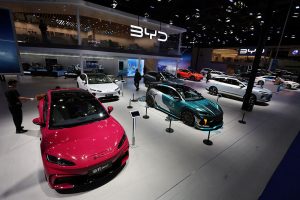
Demand for BEVs alone could be driven by the rollout of vehicle models by firms like BYD Cars Philippines, Chery Auto Philippines, MG Motor Philippines, VinFast Auto Philippines, Inc., and Tesla Motors Philippines, Inc.
“We contend that the expansion of Chinese brands will be particularly important because it will reduce the price gap between EVs and comparable ICE vehicles while increasing consumer awareness of electrified technology,” BMI said.
In the January-to-July period, total EV (xEV) sales more than doubled to 38,286 units, but total vehicle sales fell by 10.2% to 241,725 units, according to the Chamber of Automotive Manufacturers of the Philippines, Inc. (CAMPI) and the Truck Manufacturers Association (TMA).
CAMPI-TMA data showed that xEV sales accounted for 6% of total automotive sales in the seven-month period.