By Justine Irish D. Tabile, Senior Reporter
THE PHILIPPINES could still achieve at least 3.8% economic growth this year but would need “significant acceleration” in government spending and a recovery in household consumption, the Asian Development Bank (ADB) said.
“It is challenging, but we think reaching 3.8% is possible, attainable but hinges on a strong second-half recovery in project execution and household consumption,” ADB President Masato Kanda told reporters on Monday.
The multilateral lender had lowered its Philippine gross domestic product (GDP) forecast to 3.8% in July from 4.4% in April, reflecting delayed investments and weaker household consumption.
ADB Country Director Andrew Jeffries said their economic projections are being finalized to reflect the latest economic data. The Asian Development Outlook will be released on Sept. 23.
“We are still doing the numbers, but between early July and now, new data has come out and everything. I mean, there’s always some changes, sometimes positive, sometimes negative,” he said.
The ADB’s July estimates were released before second-quarter data showed the Philippine economy grew by 2.3% — a new post-pandemic low. GDP growth averaged 2.6% in the first half, still below the government’s downwardly revised 3.5-4.5% target for the year.
Mr. Kanda said soft second-quarter growth was largely due to high inflation that dampened consumption, while tighter oversight contributed to delays in the implementation of infrastructure projects.
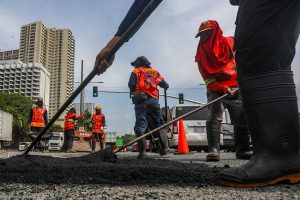
“So, to meet the target, we must see a significant acceleration in public investment execution,” he said.
Household final consumption expenditure grew by just 2.8% in the second quarter, slowing from 5.2% a year earlier and 3% in the first quarter.
Gross fixed capital formation declined by 13.7%, reversing the 3.1% growth recorded a year earlier and worsening from the 2.5% contraction in the first quarter, as public construction plunged by 32.4%.
Infrastructure and other capital outlays fell by 40.8% to P367.4 billion in the first half from P620.2 billion a year earlier, according to the latest Department of Budget and Management data.
Mr. Kanda said the main challenge facing the government’s infrastructure program is increasingly project execution rather than financing.
“While strengthening oversight is the right direction, we’ve got to do that. The critical task now is to simultaneously rebuild efficient project delivery,” he said.
Mr. Kanda said the ADB is supporting public financial management reforms, including the digitalization of government systems, to improve transparency.
“By modernizing this system, we help ensure that public funds are budgeted, monitored, and spent transparently,” he added.
Meanwhile, Mr. Kanda said the Philippine economy is expected to recover in 2027, supported by stronger public investment execution and easing inflationary pressures.
“We forecast growth to 5.3% and inflation to 3.9% in 2027. So, over the medium term, the growth outlook remains somewhat positive, supported by reforms, including expanding opportunities for foreign investment, which ADB strongly supports,” he said.
Mr. Kanda said unlocking private investment would require a predictable regulatory environment and stronger domestic capital markets.
“We must continue to make markets investable and mobilize private sector finance expertise and innovation at scale,” he added.
The ADB expects to make more private sector commitments in the Philippines in the coming years, Mr. Kanda said.
The multilateral lender committed $143.3 million to private sector operations in the Philippines in 2025, trailing Vietnam, Thailand and Indonesia among Southeast Asian markets.
Of the total, $129.8 million went to long-term financing, supported by $95.8 million in mobilized funding. The ADB also committed $13.6 million to short-term financing and mobilized an equivalent amount.
Mr. Kanda said the Philippines has significant potential to attract global equity, but needs a more predictable and credible investment environment.
“They need predictability and credibility, and of course, without corruption. So, I think one of the things we have to focus on is creating the environment by regulatory reform and cultivating the domestic capital market. This is the thing we are now strengthening,” he said.
Mr. Jeffries said the ADB is interested in financing private sector projects including those in offshore wind energy.
“ADB is less needed for conventional renewable energy finance now because a lot of local commercial banks are very competitive. They can lend long-term at good prices in pesos,” he said.
“There’s interest in, I think, more financial inclusion type of investments like the GCash loan. There’s interest in agribusiness. So, it’s sectors with a development angle to them,” he added, referring to the $29.8 million allocated to Fuse Financing, Inc. to expand lending to micro-, small- and medium-sized enterprises through GCash.