1 of 3
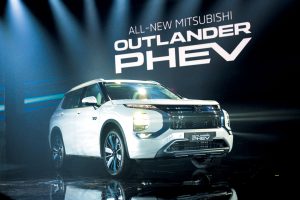
The all-new Mitsubishi Outlander PHEV is priced at P2.848 million, with an introductory tag of P2.749 million until Sept. 30.
MMPC officials flank the all-new Mitsubishi Outlander PHEV. From left are Assistant Vice-President for Sales and Marketing Miko Hernandez, Executive Vice-President for Sales and Marketing Toshiaki Kato, President and CEO Ritsu Imaeda, First Vice-President for Sales and Marketing Cesar “Jack” Ramirez, and Assistant Vice-President for Sales and Marketing Allan Cruz.
Mr. Imaeda addresses the audience.
Outlander PHEV returns with all-new iteration
MITSUBISHI MOTORS Philippines Corp. (MMPC) formally launched the all-new Mitsubishi Outlander PHEV (plug-in hybrid electric vehicle) SUV recently in Quezon City — highly touted as Japan’s best-selling PHEV SUV.
In an interview after the launch, MMPC President and CEO Ritsu Imaeda noted that the previous-generation Outlander was introduced in the Philippines “a couple of years back.” But while that model was more of a showpiece, the all-new iteration, added the executive, “is being launched as a mass production car… (to meet) rising demand for NEVs (new energy vehicles).”
He expressed belief that the Outlander PHEV, now taking its place as MMPC’s flagship model, will be well-received. “We are confident on this introduction of this model to deliver the highest quality to the customers,” Mr. Imaeda continued.
First previewed at the Philippine International Motor Show in June, the Outlander PHEV garnered “pretty positive” feedback from showgoers. The executive is further banking on Mitsubishi’s “close to 15 years of experience” with plug-in hybrid development and refinement to appeal to segment browsers.
“And this model is not only a simple plug-in hybrid system; it is combined, with the technology of Super All-Wheel Drive Control (S-AWC). What is crazy about this model is that the control of the motor is used for the regulation of the car. Why so? It is used (for) the customer’s safety and security… and assuring the good drive of the vehicle,” he added.
S-AWC, according to MMPC, is a “fully integrated system” that conscripts Twin-Motor 4WD, active yaw control, anti-lock braking, active stability control, and traction control. These continuously optimize traction, stability, and handling for greater driver confidence and control “across a wide range of road and driving conditions.”
The all-new Mitsubishi Outlander PHEV is primarily powered by a 2.4-liter gasoline engine, fitted with a Mitsubishi Innovative Valve timing Electronic Control (MIVEC) system, the brand’s proprietary name for its variable valve timing (VVT) engine technology. This is said to enhance power and fuel efficiency, while lowering exhaust emissions. The Outlander also gets front and rear electric motors — leading to MMPC declaring it as offering the “best of both worlds,” with an ability to “intelligently switch between electric and gasoline power to deliver exceptional performance while maximizing efficiency.”
The system outputs a total of 306ps and 450Nm, resulting in responsiveness and smooth acceleration. As for the driving range between gas and battery top-ups, the Outlander is said to be able to deliver “almost 1,000 kilometers” — 100km of which is pure electric range.
The gasoline engine is engaged automatically whenever more power or range is needed. For the new model, the driver can switch from multiple EV drive modes (Normal, Save, Charge, and EV Priority) for greater driver control and peace of mind. The battery can be charged via AC Type 2 charge points. Given that it’s a hybrid, drivers can drive worry-free even when there’s no charge point available.
Meanwhile, there are seven selectable drive modes, “grouped according to driver preference and road conditions.” Everyday driving modes include Normal, Eco, and Power; Tarmac, Gravel, Snow, and Mud “optimize power delivery and traction control” depending on off-road or difficult conditions.
Mr. Imaeda said that Filipinos are already showing increased interest in electrified vehicles — with an initial conservativeness toward new technologies curbed by war in the Middle East, consequently driving up prices at the pump.
“It has been triggering the transition to the hybrid models,” he declared. “Right now, not all of the customers are jumping into hybrid technology. But eventually, as time passes, I think the confidence with this new type of vehicles is going to increase.” — Kap Maceda Aguila
