1 of 7
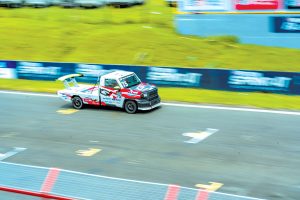
A Toyota Tamaraw OMR (one-make race) speeds on the Batangas Racing Circuit. — PHOTO BY KAP MACEDA AGUILA
Toyota Vios OMR unit — PHOTO BY KAP MACEDA AGUILA
GR-prefaced Toyota models were also able to take to the track for timed laps. — PHOTO BY KAP MACEDA AGUILA
Tamaraws jockey for position around a corner. — PHOTO BY KAP MACEDA AGUILA
Toyota Motor Philippines (TMP) President Masando Hashimoto is introduced ahead of the race. — PHOTO BY KAP MACEDA AGUILA
Joining the photo opportunity with the racers in the front row are (from left) TMP Senior Vice-President for Marketing Ryo Yokoyama and TMP First Vice-President for Vehicle Sales Operations Marketing Elijah Marcial. — PHOTO BY KAP MACEDA AGUILA
TMP officials pose with racers. In photo are (rightmost) Lexus Manila President Carlo Ablaza, TMP Senior Vice-President for Marketing Sherwin Chua Lim (beside Mr. Ablaza), and TMP Executive Vice-President Jose Ma. “Jing” Atienza (above Mr. Chua Lim). — PHOTO BY KAP MACEDA AGUILA
TGR PHL Cup takes on ‘more technical’ course
LAST WEEKEND, the Toyota Gazoo Racing (TGR) Philippine Cup made its first-ever stop at the Batangas Racing Circuit (BRC). While the facility is smaller compared to the usual haunt of the grassroots race series, the Clark International Speedway, the BRC is considered a more difficult course.
“The BRC is a true racer’s track — fast, technical, and relentlessly demanding. Blind corners unfold one after another, rewarding precision, preparation, and commitment. For drivers who trust their craft, BRC has long been a dream circuit: a place that tests both skill and courage,” wrote Toyota Motor Philippines (TMP) President Masando Hashimoto on Facebook. The executive has been consistently participating in the series for three years already.
Located in Barrio Maligaya, Rosario, Batangas, the BRC turns 30 years this coming Oct. 16. It stretches 3.5 kilometers, features 20 turns, and runs clockwise. You could also say it doesn’t suffer fools gladly. Mr. Hashimoto narrated that just before the race weekend (the third this year), he “made the call to change the brake specification” to enhance stopping power available to participants given the technical nature of the BRC. “Every driver deserved confidence in the car and consistency under braking. To reduce the risk of a serious incident, there was no other choice,” the executive continued.
Meanwhile, TMP Assistant Vice-President for Marketing Services Jade Sison-Mendoza said to “Velocity,” “Coming to BRC is also a result of the Toyota philosophy of making ever-better cars, kaizen (continuous improvement or change for the better), and the evolution of the race into a ‘rolling laboratory’ like the previous race featuring biofuels. The BRC is another way to improve drivers’ skills, how they drive the Tamaraw and Vios.”
The use of biofuels, initiated in the previous race leg, is not just about being mindful of the volatile fossil fuel prices because of the US-Iran war, but has a long view toward lessening the country’s dependence on fuel imports and exploring the realm of more sustainable biofuels. In turn, this will put a needed spotlight on local agriculture.
The Vios OMR (one-make race) units continued to use E20 fuel, a 20% bio-ethanol blend, while the Tamaraw OMRs were topped up with B5 fuel, a 5% coco-biodiesel blend. “This initiative to use low-carbon biofuels began in the previous race weekend and aims to support national energy security and the development of biofuel supply chains through multi-stakeholder collaboration including the agricultural sector,” said TMP in a release.
Following the previous race, TMP First Vice-President for Corporate Affairs Josephine Villanueva said, “We have received positive feedback from the racers on how biodiesel and bioethanol blend fuels perform on extreme conditions, so we are further studying the feasibility of continuing the use of these low-carbon fuels for our succeeding motorsports events. While we continue to face energy security issues in the country, we hope this initiative will result in improved knowledge on the positive benefits of higher biofuel blends for wider use of motorists.”
Added Mr. Hashimoto, “Thanks to everyone’s hard work, all 17 Tamaraws took to the track across three final races. There were a few racing incidents, damaged cars, and retirements — as can happen in any hard-fought race — but no serious injuries. Every situation was managed promptly, and every driver went home safely. That was not luck. It was preparation, teamwork, discipline — and a shared refusal to compromise on safety.”
The final race day of the TGR Philippine Cup 2026 season is on Sept. 12 at the Clark International Speedway in Pampanga.
