He must have felt ecstatic, standing in line with his mistahs that graduation day in March 1941.
After all, these grads in their early 20s had survived four years of grueling physical conditioning (including daily brutal hazing in their plebe/freshman year that is now banned) that added to the pressure of academics.
Just nine months after leaving the long gray line at the Philippine Military Academy (PMA), he and his “mistahs” found themselves at war with an invader that had crushed Chiang Kai-shek’s forces and steamrollered its way southward into and past Southeast Asia — fresh “green” troops facing grizzled veterans who had swept aside all opposition that had stood in their way.
He fought in Bataan, escaped the Death March, evaded Japanese patrols as he navigated swamps towards Bulacan, where he joined guerrillas who carried on the war to victory in the end.
The first year of that war killed half of his PMA class.
Five years after the war ended in 1945, he next found himself with allied forces fighting in the Korean War, and, after that, came home to fly air sorties against communist and Moro insurgents.
By the time he retired, he was one of the armed forces’ 11 generals (a total that already included one or two navy commodores) — compared with hundreds each in our military and police establishments nowadays — at a time when our military stood second to none in Southeast Asia.
LIKE CANDY
For all his troubles in all his 30 war-torn years in the military, my father sported just four rows of ribbons, each representing a hard-earned medal, many of them in combat. Yet, he never won the Gold Cross or any higher medal for “gallantry in action.”
With nearly every solider with a long track record of intense combat at that time, I guess the bar could have been just a bit higher then.
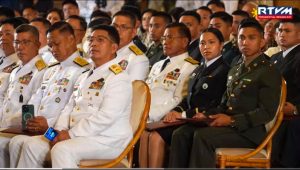
And so, you can imagine my wonder at the sight of influential folks — a couple of them with questionable public backgrounds or even mouthing Beijing’s propaganda on the West Philippine Sea issue — donning the uniform of a senior officer in the reserve force with chests bedecked with awards, many of them “earned” in less than a decade and enough to fill even up to nine rows. Gosh, when and where did these folks fight battles?
At times, I wonder if such gilded personalities will have what it takes to lead us and our sons FROM THE FRONT into battle, should we as a country be forced into such an extreme measure… and I shudder at the thought.
Thus, I understand where critics — especially a few soldiers who have been increasingly vocal on social media of late — of the perceived lax conferment of ranks and awards on public personalities are coming from. Asked on this perception, one retired general admitted that public personalities’ influence may be a key — though not the only — consideration in being conferred ranks and awarded medals.
It was a welcome development for the Philippine Air Force’s Reserve Command to announce that it would review its policies on the conferment of awards and “honorary” badges(!) to reservists. But the question immediately arises: “Only that unit?” Because the public perception nowadays — whether or not true — is that the practice of handing out reserve ranks and awards like candy to public personalities has been more prevalent than the armed forces cares to admit.
True, there are laws, rules and regulations like Republic Act No 7077, or the “Citizen Armed Forces of the Philippines Reservist Act,” AFP Circular No. 30, as well as special guidelines for presidential appointees and other government officials, but have there been cases when any of these statues been bent? For our country is known to have adequate laws but notoriously weak enforcement. For example, medals and other awards may be covered, pro forma, by general orders or any other required documentation, but were specific individual circumstances (e.g., where and when exactly did the fellow perform the act that merited the award) verified?
THE BIGGER PICTURE
This issue is particularly important at a time when the armed forces has been chalking up one of the best public satisfaction ratings among state institutions for quite some time now. And this at a time when public respect for many other key institutions has been dismal.
It takes on even greater significance at a time when we have been modernizing and strengthening our armed forces — including our reserves — in the face of external threats, first and foremost, in the West Philippine Sea as well as the increased risks of disasters. This worthwhile, necessary effort involves not only the acquisition of modern weapons, communications, electronic as well as command and control platforms, but — equally vital — development of quality manpower to maximize the use of these systems. For human capital is a resource at the heart of any organization.
And, unfortunately, there are signs that this controversy of still-unverified “stolen valor” may have struck a chord among some purported combat veterans (not the sort of people you would want to mess with). I do not know if it is just a function of algorithms, but a number of individuals claiming to be active or retired soldiers (I have verified just a couple) have been posting their list of medals on social media, saying, basically, that while these awards were just a handful, each one was proudly and rightfully earned. One wonders, though, why none of these posts was in Filipino. Hmmm…
But assuming that all these posts were genuine, then they point to the worrisome specter of division, and potential restiveness within the ranks of our troops that has reared its head occasionally since the past administration — with issues ranging from the perceived realignment towards China under former President Rodrigo R. Duterte to the alleged partial investigations of the flood-control mess under the current administration.
A retired general who formed part of the core group of coup plotters against past administrations said that such restiveness has not erupted into outright rebellion since calls for the withdrawal of armed forces support from the current government have been perceived as forming part of partisan politics, thus, rendering mobilization efforts inutile, so far.
But this issue of alleged “stolen valor” seems to be different, since it has apparently struck a raw nerve among some of our professional soldiers, with some saying that either they nearly died or a comrade died without earning a medal for bravery. It may be a matter which a typical civilian may brush aside as something that does not concern him, but it could hide a cancer in our armed services that could eventually bite us all.
We may recall that military factionalism, politicization of and perceived inadequate military leadership, irregularities within the armed forces and grandstanding by politicians had figured among many other causes of past military uprisings that were cited in two fact-finding probes (https://tinyurl.com/btzrz9v8). Those reports pointed to military grievances, a politicized armed forces, weak civilian institutions and the belief that the military has a political mandate as a risky brew.
Significantly, one retired general who had been linked to recent destabilization efforts has been quick to jump on this controversy, perhaps recognizing its timely, unique appeal. Perhaps indicative of this issue’s resonance across partisan lines, criticisms have come from even those who said they disagreed with the general in all other matters.
Now, how can any foreign power wishing to destabilize us resist such a rare, juicy opportunity?
This is something we need like a hole in the head at a time of already-increased political risk weighing on our economy’s attractiveness to potential investors.
Hence, it is a smoldering issue that bears watching and prompt, substantive remediation, lest it add just enough tinder to burst into flames.
Wilfredo G. Reyes was editor-in-chief of BusinessWorld from 2020 through 2023.
previous post
