By Erika Mae P. Sinaking, Reporter
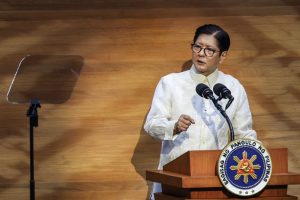
PRESIDENT Ferdinand R. Marcos, Jr. on Monday asked Congress to pass a package of tax measures, including broader income tax exemptions for low- and middle-income earners and tax exemptions for micro, small, and medium enterprises, as he laid out his administration’s legislative priorities for the remainder of his term.
In his fifth State of the Nation Address (SONA), Mr. Marcos also sought congressional approval of measures updating the country’s tax system, alongside bills that would amend the National Building Code, modernize the 25-year-old Ecological Solid Waste Management Act and establish a law to make rooftop solar panels and battery storage systems more accessible to households.
“To ensure the continued progress of the middle class amidst the lingering effects of the crisis, we will pursue tax relief measures that promote growth, generate revenue and advance equity toward socioeconomic sustainability,” he said in his speech that lasted an hour and 26 minutes.
Mr. Marcos said that the proposed tax reforms aim to protect the purchasing power of Filipinos who have felt the brunt of global economic volatility.
He called for the expansion of the current income tax framework to include more workers in the tax-exempt bracket.
“As a unique protection for them and so they can benefit more from their hard-earned income, I call on Congress to pass the law that will provide partial relief for our tax payments,” Mr. Marcos said.
“First, let us expand the exemption for income tax. Let us increase the number of workers who will be exempt from taxes on their income. We will include those earning not more than P350,000 per year,” he said.
This move would be accompanied by reduction in the income tax rates for other workers to ensure a fairer distribution of the tax burden.
He proposed a “one-time tax abatement” for microentrepreneurs to provide relief to those whose earnings have suffered during the recent period of economic hardship.
“Second, small businesses will no longer be subjected to the minimum corporate income tax,” he said.
The President pushed for a comprehensive tax amnesty covering unpaid income, estate, donor’s, and value-added taxes, including the waiver of associated penalties.
The fiscal space for these reforms is being carved out through a rigorous anti-corruption campaign, particularly within the Department of Public Works and Highways.
AMENDMENTS TO EPIRA SOUGHT
Also, Mr. Marcos called on lawmakers to approve a bill removing system loss charges from consumers’ electricity bills, saying the measure would complement the administration’s planned tax relief package by lowering electricity costs for households and businesses.
“It is not the fault of consumers why there are system losses. So, it is not right that consumers have to pay for this. Therefore, we, the people, request — no, we demand for the immediate amendment of the EPIRA (Electric Power Industry Reform Act), and to prohibit charging system loss against consumers including the value-added tax thereon,” he said in Filipino, receiving a standing ovation from the audience.
Mr. Marcos also pushed for the passage of the “Sariling Kuryente” Act to make the installation of rooftop solar panels and battery storage systems in homes “simple, easy, and affordable.”
The President said the government would continue directing funds to education, healthcare, food security and infrastructure, citing savings from its campaign against corruption, including irregular flood control projects.
Mr. Marcos reiterated support for the Public Utility Vehicle Modernization Program, saying its implementation would be “humane, affordable and just.”
He also reaffirmed the government’s target of having electric vehicles (EV) account for half of all vehicles in the country by 2040 while supporting investments across the EV value chain, including vehicle assembly, battery manufacturing and related parts.
He also announced that the 12 stations of the Metro Rail Transit (MRT) Line 7 will open by next year. “After nearly three decades, there will be a new MRT line extending to Sacred Heart, Quezon City, from North Avenue. And someday, it will reach all the way to San Jose Del Monte, Bulacan,” he added.
Mr. Marcos also touted the planned Pax Silica industrial hub, which he says would “bring quality jobs to our people, accelerate our industrial competitiveness and revitalize our economy.”
“Let us continue the work that we have started, to make the Philippines the country that Filipinos deserve,” the President said.
‘CHALLENGE IS EXECUTION’
Meanwhile, Management Association of the Philippines President Donald Patrick L. Lim said the group is encouraged by Mr. Marcos’ strong emphasis on key priorities such as job creation, food security, affordable energy, and support for small businesses, among others
“The challenge now is execution. Businesses are looking for clear implementation timelines, policy consistency, and close collaboration between government and the private sector. We hope Congress will quickly translate these priorities into legislation where needed, while the Executive ensures that programs are implemented efficiently and their benefits are felt by ordinary Filipinos,” Mr. Lim said in a Viber message.
Ederson DT. Tapia, a political science professor at the University of Makati, told BusinessWorld that Mr. Marcos’ SONA was ambitious and clearly responsive to the immediate concerns of ordinary Filipinos.
“However, many of the commitments were presented as programs rather than measurable reforms. The major test is implementation: clear timelines, funding, accountable agencies and concrete outcomes,” Mr. Tapia said.
“The speech was also notable for what it avoided: impeachment, political dynasties, human rights, budget insertions and deeper institutional reforms. In this sense, it was strong on assistance and aspiration, but less complete on structural political change,” he added.
Federation of Philippine Industries Chairperson Elizabeth H. Lee welcomed the President’s directive to lower power costs, saying it is “essential to placing Philippine manufacturing on equal footing with our ASEAN (Association of Southeast Asian Nations) peers.”
“Paired with long-term energy security — through nuclear exploration, natural gas, hydrogen, and renewables — these reforms can build true industrial resilience,” she said in a Viber message.
Thousands of protesters from labor, teachers, youth, urban poor and other sectoral groups marched along Commonwealth Avenue for the people’s SONA, presenting what they described as the country’s “true state of the nation” ahead of the President’s speech.
The demonstrators called for higher wages, increased funding for education and social services and greater government accountability, while criticizing the administration over corruption, poverty, militarization and foreign influence. — with Beatriz Marie D. Cruz and Kaizzer Angela Marie V. Manuba