By Erika Mae P. Sinaking, Reporter
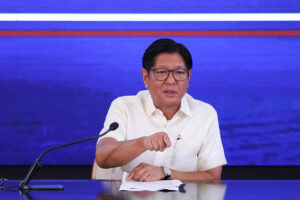
PRESIDENT Ferdinand R. Marcos, Jr. called Congress to a special session starting June 17 to fast-track pending social protection and reform measures, citing urgent needs from a recent Mindanao earthquake and energy challenges.
Under Proclamation No. 1318, the Senate and House of Representatives were directed to consider measures that have reached advanced stages in the legislative process.
“The challenges confronting our people demand urgent action,” Mr. Marcos said in a statement on Monday. “Families affected by the recent earthquake in Mindanao require immediate assistance. Students need continued support to pursue their education.”
“Our senior citizens deserve better healthcare. Our children must have better nutrition and vulnerable sectors need stronger protection,” he added.
Priority bills include the creation of the National Center for Geriatric Health, the establishment of a Presidential Merit Scholarship Program, and a proposed Anti-Political Dynasty law.
Lawmakers are also set to tackle amendments to key education support and emergency assistance programs.
The special session comes at a crucial point in the administration’s legislative calendar, with lawmakers having only a limited window to pass priority measures before attention increasingly shifts toward preparations for the 2028 national elections.
Both chambers have been on sine die adjournment since June 3 and were only scheduled to convene for their second regular session on July 27, coinciding with Mr. Marcos’ annual State of the Nation Address (SONA). The special session effectively restores Congress’ ability to act on pending measures during the nearly two-month legislative break.
Under the 1987 Constitution, the President may call Congress to a special session at any time to address urgent legislative concerns.
The session will also enable the Commission on Appointments to act on pending appointments in the Cabinet, military, and foreign service.
The special session follows weeks of legislative uncertainty in the Senate that slowed progress on several measures included in the administration’s priority agenda.
As of June, a number of the 52 priority bills identified by the Legislative-Executive Development Advisory Council (LEDAC) are still pending in the Senate.
The timing is particularly significant as Mr. Marcos prepares to deliver his annual SONA next month, which traditionally serves as both a report on government accomplishments and a roadmap for the remainder of a president’s term.
Several of the measures identified for consideration during the special session reflect the administration’s continuing emphasis on social welfare and human capital development.
The proposed National Center for Geriatric Health seeks to strengthen healthcare services for the country’s growing elderly population, while the Presidential Merit Scholarship Program aims to expand educational opportunities for academically qualified students.
The Anti-Political Dynasty Act, meanwhile, addresses one of the most enduring reform issues in Philippine politics. Although the 1987 Constitution directs Congress to prohibit political dynasties, lawmakers have repeatedly failed to pass enabling legislation over the past four decades.
RUNNING OUT OF TIME?
Edmund S. Tayao, president and chief executive officer of Political Economic Elemental Researchers and Strategists, said Mr. Marcos is entering a critical phase of his presidency, with limited time remaining to secure the passage of key legislative measures before attention turns toward succession politics and the next presidential race.
“Note that it’s June and the President is to deliver his technically last SONA before his farewell SONA… Unfortunate as it is, this is the only time the President is left to accomplish what can still be accomplished,” Mr. Tayao told BusinessWorld via a Facebook chat.
Among the proposed measures, Mr. Tayao said the Anti-Political Dynasty Act stands out as the most politically consequential.
“The (passage of the Anti-Political Dynasty Act) will either define his presidency politically. Except for the latter, I believe all the others could be multipartisan, which therefore should be easy to pass,” he said. “If delayed, it would then signal that there can be no more other legislation, especially crucial ones that can be passed.”
Anthony Lawrence A. Borja, an associate professor of political science at De La Salle University, said the decision underscores the considerable agenda-setting powers exercised by the Executive branch.
“To reverse the imagery of a Senate riddled with absentees and instabilities, this call for a special session gives the impression of a capacity to go above and beyond what is required of legislators (well, given already low expectations),” he told BusinessWorld in a separate Facebook chat.
Mr. Borja said that by requiring lawmakers to deliberate on pending measures, the administration can project an image of institutional functionality and responsiveness despite political tensions.
“Some of the urgency is real — a recent earthquake in Mindanao has left families in need of immediate government response and assistance, and several military generals are at risk of losing their promotions if Congress doesn’t confirm them before they hit mandatory retirement age. Those are hard deadlines that can’t wait until July,” Arjan P. Aguirre, a political science lecturer at the Ateneo de Manila University, said in a separate Facebook chat.
Mr. Aguirre said the administration appears to be using the special session not only to address humanitarian and institutional concerns but also to advance a broader legislative agenda and restore momentum in the Congress.
“(This special session) says the administration wants to be seen as governing, not just politicking. The focus on social protection, education, and healthcare is a deliberate signal to ordinary Filipinos — especially those hit hardest by rising energy costs and natural disasters — that the government is working for them,” he added.